
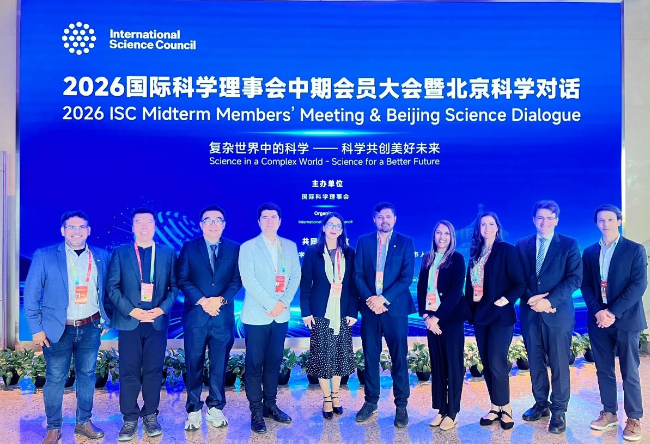
Twelve members and alumni of the Global Young Academy (GYA) have been appointed to the new cohort of International Science Council (ISC) Fellows, recognising their outstanding contributions to science and their commitment to advancing science as a global public good.
Additionally, GYA alumnus Javier Garcia-Martinez (University of Alicante, Spain), has been elected to the ISC Governing Board, one of the ISC’s key decision-making bodies.
Altogether, these appointments represent an important development for the GYA community and highlight the impact and leadership of its past and current members in international scientific cooperation.
The 12 GYA members and alumni appointed as ISC Fellows are as follows.
Alumnus Federico Rosei (Université du Québec, Canada)
Alumnus Ho Cheung (Anderson) Shum (University of Hong Kong, China) – nominated by the GYA
Member Lobna Said (Nile University, Egypt)
Alumna Luciana Balboa (University of Buenos Aires-CONICET, Argentina)
Member Mandira Lamichhane Dhimal (Planetary Health Research Centre, Nepal)
Alumnus Martin Dominik (University of St Andrews, United Kingdom)
Alumna Priscilla Kolibea Mante (Kwame Nkrumah University of Science and Technology, Ghana) – nominated by the GYA
Member Rita Orji (Dalhousie University, Canada)
Alumna Roberta D’Alessandro (Utrecht University, Netherlands)
Alumna Shymaa Enany (Suez Canal University, Egypt)
Alumna Sri Fatmawati (Institut Teknologi Sepuluh Nopember, Indonesia)
Alumna and Immediate Past Co-Chair Yensi Flores Bueso (University College Cork, Ireland)
GYA contributes to global science dialogue in Beijing
The announcement of the new ISC Fellows coincided with the International Science Council (ISC) Midterm Members’ Meeting and Beijing Science Dialogue, held in Beijing, China, from 19–23 October 2026 under the theme “Science in a Complex World – Science for a Better Future”. The gathering brought together more than 1,000 representatives of the scientific and technological community from 88 countries and regions to discuss the role of science in addressing global challenges.
The GYA was well represented at the meeting by its current Co-Chairs Natisha Dukhi (Human Sciences Research Council, South Africa) and Francesco Maurelli (Constructor University, Germany), as well as current and past Executive Board Members, Founding Members, and a number of further members and alumni.
Throughout the event, these members and alumnni participated in the dedicated programme for early- and mid-career researchers (EMCRs), which ran alongside the main event. Discussions focused on three overarching themes: science as a global public good, responsible artificial intelligence (AI) for global challenges, and science, society and trust.
The EMCR programme included workshops on AI readiness and science communication, as well as panel discussions in which participants shared their experiences and challenges in integrating AI into their research. These exchanges highlighted the importance of involving EMCRs in shaping discussions about emerging technologies and ensuring that their expertise and perspectives inform international scientific priorities.
The programme concluded with the Early- and Mid-Career Researchers Forum on 22 October. GYA representatives also visited the International Research Center of Big Data for Sustainable Development Goals (CBAS), exploring further opportunities for scientific cooperation.
Beijing Science Declaration calls for stronger international cooperation
A key outcome of the Beijing Science Dialogue was the release of the Beijing Science Declaration: Science in a Complex World – Science for a Better Future on 21 October. The Declaration sets out 18 commitments to strengthen international scientific cooperation and help shape the global science agenda beyond 2030.
Its priorities include safeguarding an open, inclusive, and cooperative global science system; advancing responsible AI for shared global challenges; strengthening trust between science and society; and ensuring that scientific knowledge informs decisions about the future.
Importantly, the Declaration calls for early-career scientists to have meaningful opportunities to contribute to global agenda-setting and public policymaking. It also emphasises scientific freedom, equitable access to research infrastructure and knowledge, international researcher mobility, open science, and improvements to research assessment systems.
These commitments closely align with the GYA’s mission to give young scientists a voice in international science-policy discussions and ensure that their perspectives are represented in decisions shaping the future of research.