
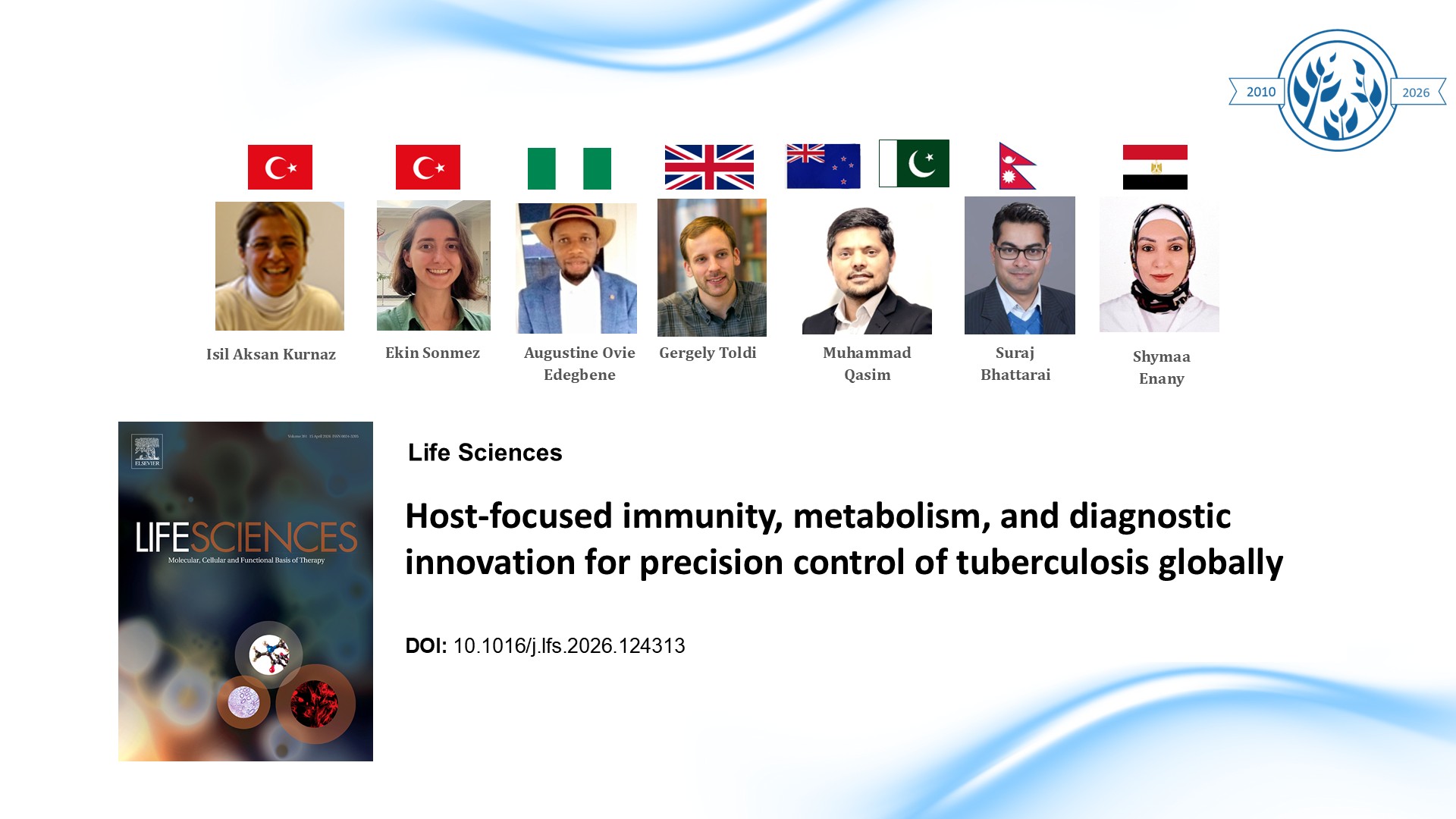
A team of GYA members and alumni has published a new review paper in the journal Life Sciences. The article, “Host-focused immunity, metabolism, and diagnostic innovation for precision control of tuberculosis globally,” presents a forward-looking analysis of tuberculosis (TB) research, arguing that global control efforts must expand beyond traditional pathogen-focused approaches.
The team of authors, led by Shymaa Enany (Suez Canal University, Egypt), includes Isil Aksan Kurnaz (Gebze Technical University, Turkey), early-career researcher Ekin Sonmez, Augustine Ovie Edegbene (Federal University of Health Sciences, Otukpo, Nigeria; Nigeria), Gergely Toldi (Birmingham Women’s Hospital, United Kingdom), Muhammad Qasim (Premium International Hospital, Pakistan / Cytotech, New Zealand; New Zealand / Pakistan), and Suraj Bhattarai (London School of Hygiene & Tropical Medicine, United Kingdom/Nagasaki University, Japan;, Nepal).
The authors synthesize emerging evidence on host-directed therapies, trained innate immunity, and immunometabolic reprogramming as complementary strategies. They also evaluate advances in rapid diagnostics, including multi-omics biomarkers, breath analysis, and smartphone-integrated tools, and discuss how artificial intelligence can integrate these data layers for personalized medicine.
Shymaa Enany, GYA member and corresponding author, said, “Ending tuberculosis requires a fundamental paradigm shift: from exclusively targeting the bacteria to strategically strengthening host resilience. In this review, we map out how trained immunity, immunometabolism, and multi-omics diagnostics can converge within an AI-driven framework to create a truly host-inclusive approach. This is not just about new technology; it’s about reimagining TB care as a precision medicine challenge that must be delivered equitably, especially in the communities that bear the highest burden.”
The paper emphasizes the importance of interdisciplinary collaboration, standardized workflows for biomarker validation, and the translation of cutting-edge science into field-ready applications. It serves as a call to action for researchers, clinicians, and policymakers to embrace a host-inclusive framework to accelerate TB elimination globally.