

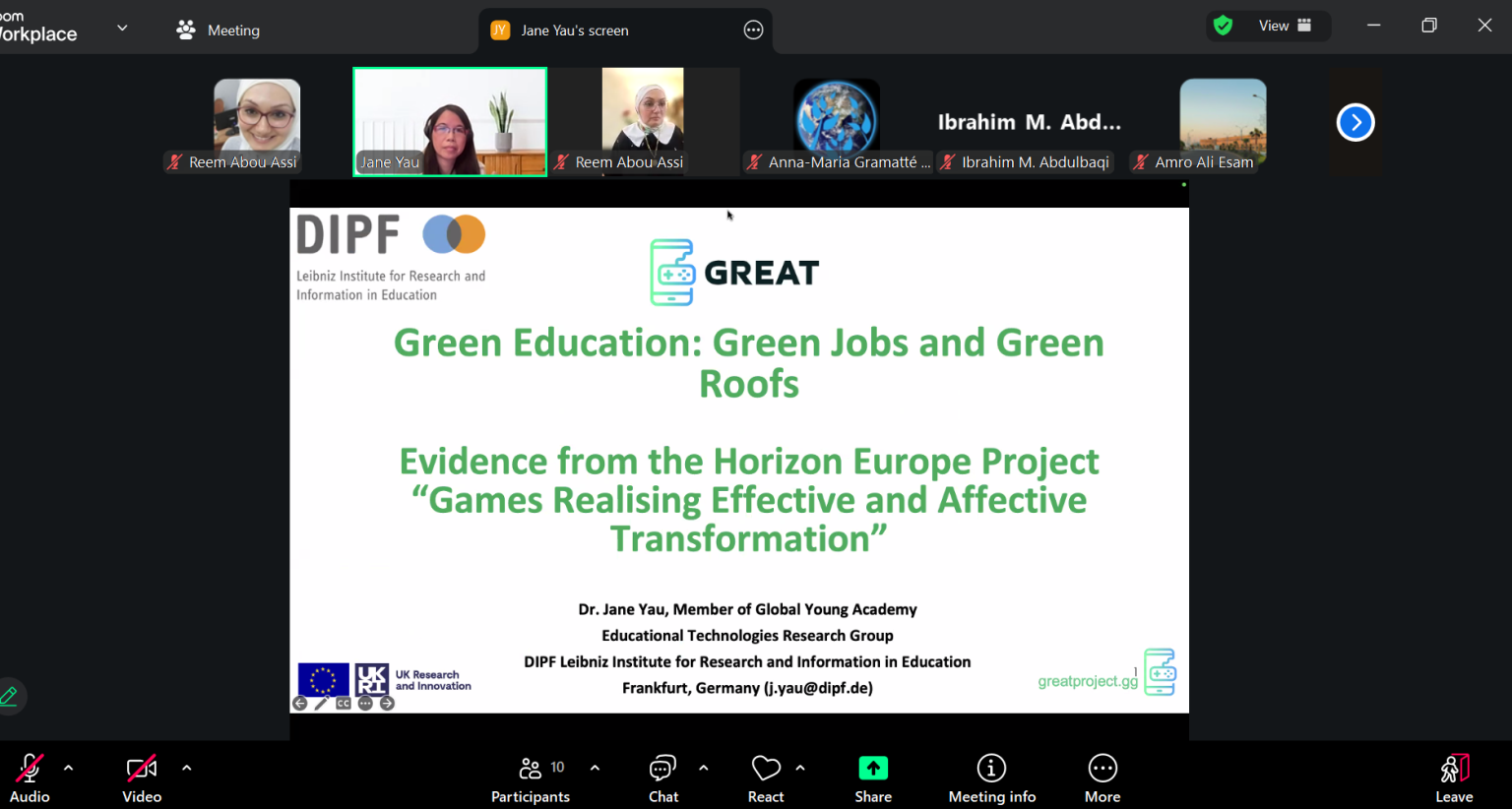
What if playing a game could help save the planet? This question drives the €3 million Horizon Europe project GREAT (Games Realising Effective and Affective Transformation), which is pioneering the use of dilemma games to transform citizen engagement with climate policy.
On 17 March 2026, the GYA convened over 30 researchers from Iraq, Germany, and beyond for a transnational research dialogue to explore how game-based methodologies can advance the green transition. The results reveal unprecedented demand for sustainability capacity-building among early-career scientists.
The interactive knowledge exchange titled “Green Education: Green Jobs and Green Roofs,” examined the intersection of sustainability science, educational technology, and citizen engagement. The session showcased methodological innovations from the GREAT project, demonstrating how dilemma games can serve as scientific instruments to measure public policy preferences while simultaneously fostering environmental literacy.
Project context: GYA Theme 3 on Bridging Science and Society
This dialogue was organized under the GYA’s Theme 3: “Bridging Science and Society,” specifically contributing to the project “Reconstructing Resilience: Steps Towards Disaster Resource Management in Iraqi Academic and Research Laboratories.”
The project, co-led by GYA Executive Committee member Reem Abou Assi (Al-Qabas College, Department of Pharmacy, EDEN Research Group, Iraq) and GYA member Fun Man Fung (University College Dublin, School of Chemistry, Ireland), investigates how research institutions in challenging environments can develop resilient laboratory safety protocols and sustainable resource management practices. Theme 3 Coordinators are Alexandra Milanova (Bulgarian Academy of Sciences, Institute of Balkan Studies & Centre of Thracology, Bulgaria), Tomislav Meštrović (University North, University Centre Varaždin / Dept. of Nursing, Croatia), and Aram Simonyan (American University of Armenia, Social Sciences, Armenia).
The dialogue team
GYA member and former co-lead of Science and Education for Youth Working Group Jane Yau (DIPF Leibniz Institute for Research and Information in Education, Germany) served as the featured speaker. Jane is a Senior Researcher specializing in educational technologies, game-based learning, and inclusive education
Reem moderated the session and contributed expertise in science education, sustainability, and the empowerment of researchers in underrepresented regions.
Institutional support and collaboration
The dialogue was supported by the GYA Office, with project coordination by Senior Project Officer Anna-Maria Gramatté and communications support by Senior Communications Officer James Curtiss, ensuring broad dissemination and professional execution.
Institutional collaboration was provided by Al-Qabas College (Iraq) through its Occupational Safety and Health Unit and Continuing Education Department, with the support of Professor Dr. Tariq Younis Ahmad, Dean of Al-Qabas College; Professor Dr. Basima Ahmad Abdullah, Deputy Dean for Scientific Affairs; and Head of the Continuing Education Unit, Shayma Mahmoud Ismail
Research context and methodology
The webinar presented findings from the GREAT project (2023-2026) , a Horizon Europe initiative investigating how computer games can improve climate protection through enhanced citizen-policymaker dialogue. The project employs a co-design methodology wherein researchers, policy stakeholders, and citizens collaboratively develop dilemma games that simulate real-world policy decisions. These games serve dual functions: educational tools for raising environmental awareness, and data collection instruments for capturing citizen policy preferences.
A featured case study examined the “Reutilization of Urban Rooftops in Nicosia, Cyprus,” where researchers are investigating incentive structures that could encourage building owners to adopt green roof policies. This work addresses a critical environmental challenge: in 2021, Nicosia had Europe’s lowest urban tree coverage at just 4%. The research brings together academic partners, the citizen group Urban Gorillas, policy experts from the European Chemical Regions Network (ECRN), and technical specialists from the Cyprus Energy Agency to understand how policy mechanisms can drive urban sustainability transformations.
The research employs a design-based research approach, iteratively developing game content through stakeholder consultation, wireframe prototyping, and empirical evaluation. This methodology generates qualitative and quantitative data on citizen attitudes toward environmental policies, providing policymakers with evidence-based insights for aligning climate protection measures with societal needs.
Evidence of impact: Researcher demand for green skills training
Beyond the formal presentations, the session captured valuable insights from participants through interactive polling, revealing strong researcher engagement with green education topics. When asked about their familiarity with Green Education and Green Workplace concepts, over 60% of attendees indicated they possessed prior knowledge of these areas, demonstrating a solid foundational understanding within the research community. More compelling was the near-universal recognition of the importance of these topics: more than 95% of participants affirmed that green education principles hold critical value for contemporary research and professional practice.
Most striking was the overwhelming appetite for capacity building. A full 100% of attendees expressed willingness to acquire new skills or enroll in courses to actively implement green education principles and workplace regulations within their own institutional contexts, a unanimous call for expanded training opportunities. Participants also shared a particular interest in the intersection of environmental practices with game-based learning methodologies, recognizing the potential of innovative pedagogical approaches to make complex sustainability challenges more accessible and engaging.
This enthusiasm translated into a clear message for future programming, with strong demand expressed for additional GYA-facilitated events exploring how creative methods, particularly game-based learning, can drive real-world environmental action and policy engagement.
These findings provide clear evidence for investment where early-career researchers are not only aware of green education principles but also nearly universally recognize their importance and, most critically, are ready to engage with training opportunities. This signals substantial untapped demand that funding agencies can address through targeted capacity-building programmes.
Implications for future research and collaboration
The webinar’s findings carry implications for science engagement strategies, continuing education programme design, and cross-cultural research collaboration. The demonstrated demand for green skills training among early-career researchers suggests that funding agencies and educational institutions should prioritize sustainability competencies within professional development frameworks. The event also validated the GYA’s model of transnational research collaboration, demonstrating how digital platforms can facilitate meaningful scientific exchange between researchers in the Global South and North.
For researchers interested in collaborating on game-based environmental education, citizen science methodologies, or green skills curriculum development, the project team welcomes inquiries through the GYA network.