

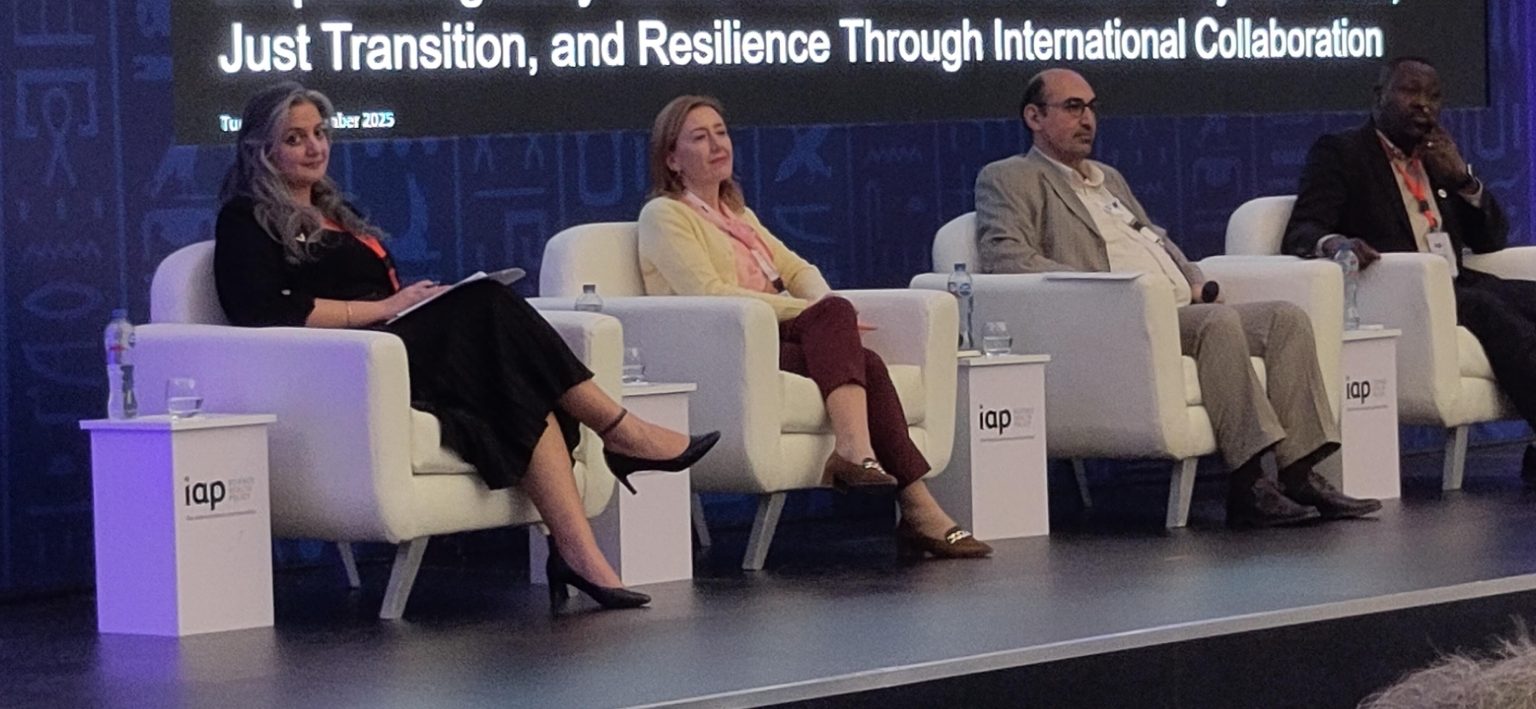
The GYA joined leading international science organizations at the IAP Triennial Conference in Cairo, Egypt, to spotlight the critical role of early-career researchers (ECRs) in addressing and navigating the world’s interconnected crises.
In the panel titled “Empowering Early-Career Researchers in Times of Polycrisis: Trust, Just Transition, and Resilience Through International Collaboration”, GYA members and partners emphasized that enabling young scientists to collaborate across borders is essential for strengthening global science systems and securing a just and sustainable future.
The session brought together GYA fellows and distinguished panelists whose work spans scientific research, science diplomacy, international development, and academic leadership:
- GYA member Hiba Baroud – Moderator – (Vanderbildt University, United States)
- Hervé Monka Lekuya – panelist – Neurosurgeon and Academic Clinician at Makerere University/Université de Kinshasa, Founder member of the Académie des Sciences pour les Jeunes (ASJ)-D.R. Congo.
- Mostafa Moonir Shawrav – panelist – Executive Director of the Marie Curie Alumni Association (MCAA)
- GYA member Aram Simonyan – panelist – (National Academy of Sciences of Armenia
- GYA member Stella Tsani – panelist – (University of Athens, Greece)
Panelists shared personal and success stories illustrating how international collaboration has shaped their careers and research impact. For many, participation in networks such as the GYA, the InterAcademy Partnership, the International Science Council, and National Young Academies and similar organizations provided not only scientific exchange but also essential peer support, mentoring, and visibility, particularly in environments where structural support for young researchers is limited. They also demonstrated how ECRs have the potential to take an independent career pathway with strong leadership, with the guidance of senior researchers.
The panel discussion highlighted the need to establish more systematic pathways for young researchers to engage meaningfully in global policy processes, particularly at the science-policy and science-society interfaces. Panelists also highlighted concrete examples of bottom-up initiatives led by ECRs.
Looking ahead, the speakers called for stronger institutional commitments to ECR participation, improved funding mechanisms, removal of institutional and legal barriers to mobility (e.g. travel and visa restrictions), support of senior-young researchers links through mentorship and leadership training, as well as trust-building practices that bring scientists closer to policymakers and society. They also discussed the role of digital technologies in fostering sustainable collaboration, while cautioning that virtual connectivity must be complemented by long-term relationship-building.
The GYA reaffirms its commitment to supporting early-career researchers worldwide and advancing inclusive, interdisciplinary collaboration as a foundation for resilient and just global transitions.